Cooling Types of Rack Mounted Load Bank and Their Characteristics
Time:2026-03-14
1. Introduction
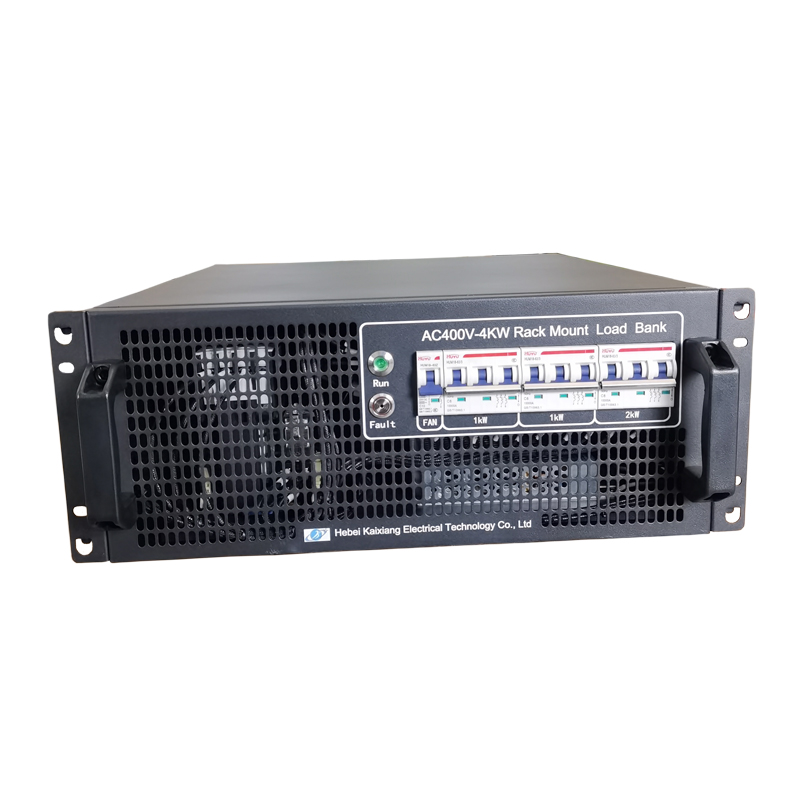
Rack Mounted Load Bank
A Rack Mounted Load Bank is a critical device for testing and maintaining power supply equipment such as data centers, UPS systems, generator sets, and batteries. It simulates real electrical loads to verify output performance, loading capacity, and stability. As it continuously generates substantial heat during operation, the cooling system directly determines the reliability, service life, noise level, and application scenarios of the equipment. This paper systematically introduces the mainstream cooling types of rack mounted load banks and their technical characteristics, providing a reference for selection and application.
Rack Mounted Load Bank
2. Air Cooling
Air cooling is the most common and basic cooling method for rack mounted load banks. It uses fans to drive airflow and dissipate heat generated by resistive elements through air ducts to the outside.
Characteristics
Simple structure and low cost
Composed only of fans, air ducts, and heat-dissipating resistors, with no complex pipelines or auxiliary equipment, resulting in low procurement and maintenance costs.
Easy installation and deployment
Standard rack-mounted design allows direct rack mounting without external water sources, cooling towers, or supporting facilities, enabling plug-and-play operation.
Convenient maintenance
Main wearing parts are fans and filters; regular dust cleaning and filter replacement are sufficient, with low maintenance requirements.
Wide application range
Suitable for indoor, outdoor, computer room, and vehicle-mounted environments, not limited by water supply conditions.
Relatively high noise
High-speed fan operation produces obvious airflow noise, which is more prominent in high-power models.
Cooling efficiency affected by ambient temperature
Cooling performance degrades in high-temperature environments; good ventilation is required for long-term full-load operation.
Application scenarios: Small and medium-power rack mounted load banks, on-site computer room testing, temporary emergency testing, and environments without water sources.
3. Water Cooling
Water-cooled rack mounted load banks remove heat from resistors through circulating cooling water, which is then dissipated by external cooling towers or heat exchange equipment.
Characteristics
High cooling efficiency and heat dissipation density
Water has a much higher specific heat capacity than air, supporting higher power in the same volume, ideal for high-density, high-power loads.
Low operating noise
No continuous operation of high-power fans, resulting in significantly lower noise than air-cooled models, suitable for noise-sensitive computer rooms.
High temperature control accuracy
Uniform and stable cooling with small temperature fluctuations of resistive elements, supporting long-term continuous full-load operation.
Smaller size and higher power density
More compact than air-cooled models at the same power level, suitable for high-density computer rooms with limited cabinet space.
Complex system and dependent on external water source
Requires supporting cooling water circulation systems, cooling towers, pipelines, valves, etc., leading to higher installation and deployment costs.
Risk of leakage
High requirements for pipeline sealing; regular inspections are needed to prevent water damage to electrical equipment.
Application scenarios: High-power rack mounted load banks, high-density data center testing, long-term continuous loading, and scenarios with strict noise and space requirements.
4. Liquid Cooling (Including Cold Plate / Immersion Liquid Cooling)
Liquid cooling is an advanced solution, including cold plate liquid cooling and insulating coolant immersion cooling, mostly used in high-end and ultra-high-power rack mounted load banks.
Characteristics
Extreme heat dissipation efficiency
Direct and efficient heat exchange with heating elements, providing far better cooling than traditional air and water cooling.
Ultra-high power density
Achieves ultra-high power in a very small volume, meeting the demands of next-generation high-density testing.
Quiet operation and stable temperature control
Almost fan-free noise, uniform resistor temperature, greatly improved reliability and service life.
High safety with insulating coolant
Uses special insulating thermal fluid that is non-conductive and non-corrosive, avoiding short-circuit risks.
High cost and complex system
Strict requirements for coolant, sealing technology, and circulation systems, leading to higher overall cost and maintenance expenses.
Application scenarios: Ultra-high-power rack mounted load banks, high-end data centers, laboratory precision testing, and long-term operation in harsh environments.
5. Summary of the Three Cooling Methods
Air Cooling: Low cost, easy deployment, simple maintenance, relatively high noise; suitable for small and medium power, water-free environments.
Water Cooling: High efficiency, low noise, high density; relies on water cooling systems; suitable for high-power, long-term computer room testing.
Liquid Cooling: Ultimate performance, ultra-high density, high reliability; high cost; suitable for high-end high-power professional applications.
In practical selection, the cooling method should be determined comprehensively based on power level, installation environment, noise requirements, water supply conditions, budget, and operating duration to ensure safe, stable, and efficient operation of the Rack Mounted Load Bank.
News Recommendation
-
 2026-08-21
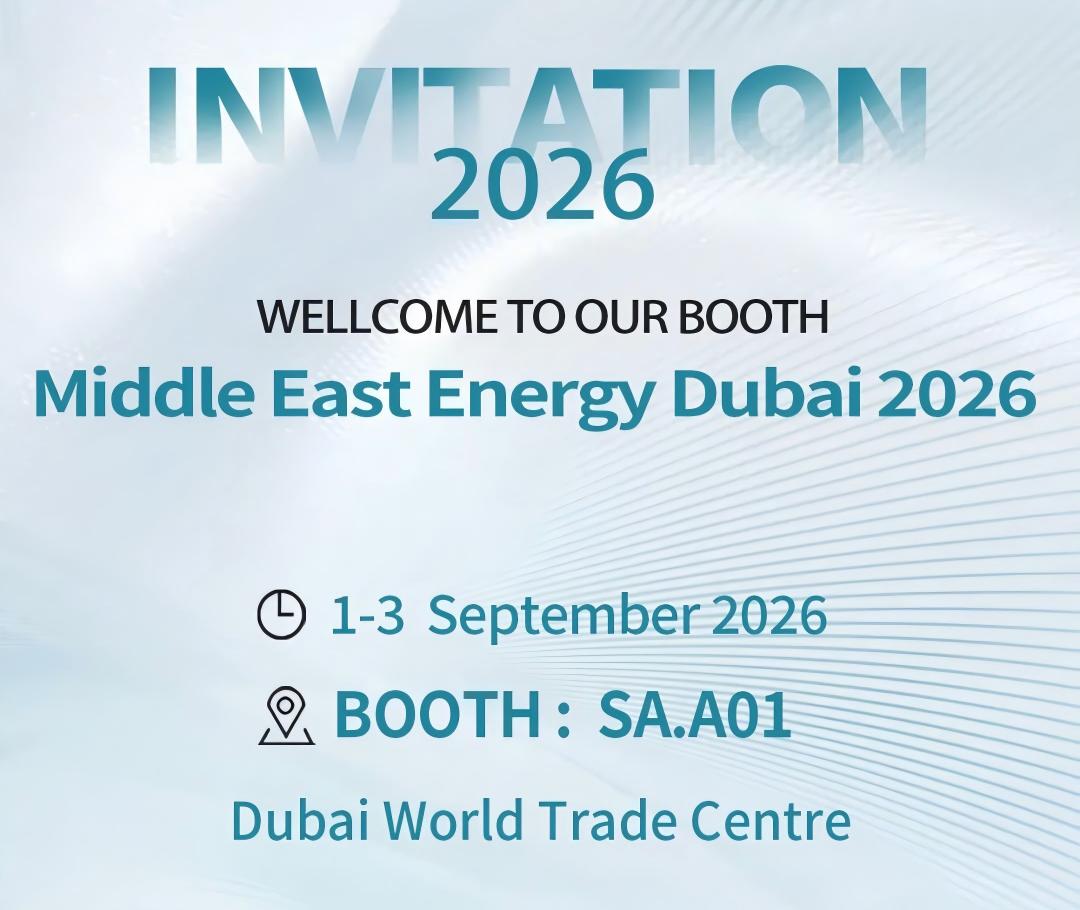
TriumphLoad to Showcase Advanced Load Banks & Dummy Load Solutions at Middle East Energy 2026
-
 2026-05-28
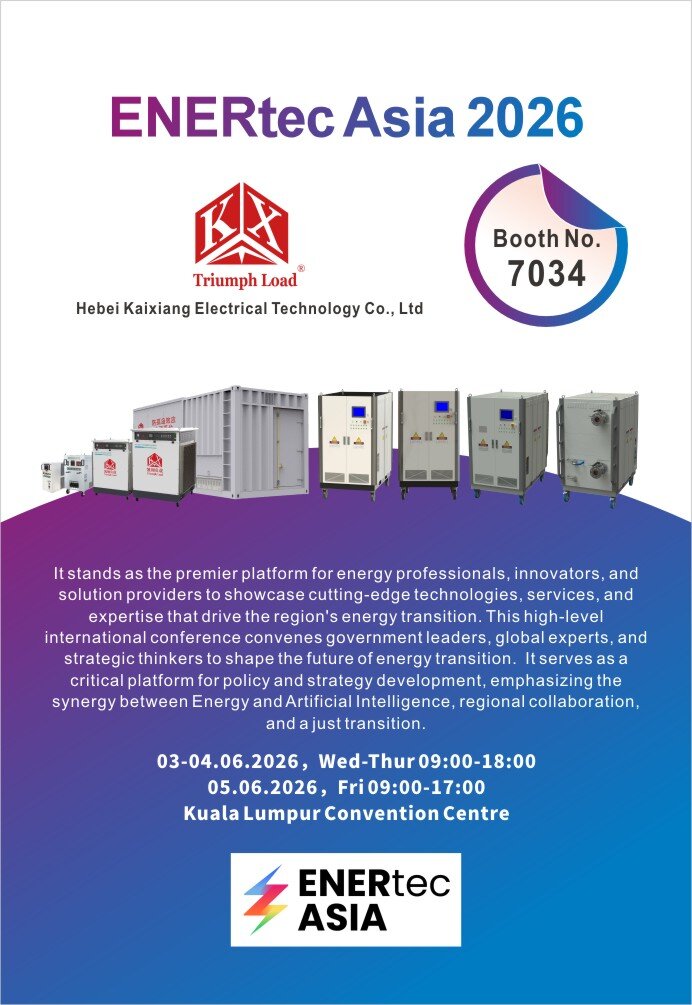
TRIUMPH LOAD EXHIBITING AT ENERTEC ASIA 2026
-
 2024-09-11
TRIUMPH LOAD EXHIBITING AT Enlit Europe 2024 -BOOTH 7.H08
-
 2023-04-21
TRIUMPH LOAD EXHIBITING AT DATA CENTER WORLD GERMANY 2023-BOOTH F909
-
 2023-04-06
TRIUMPH LOAD EXHIBITING AT ELECTRIC POWER TECH KOREA 2023 – Booth G109