Main Application Scenarios of Rack-Mounted Load Banks
Time:2026-03-10
Rack-mounted load banks are compact power load simulation devices that can be installed in standard server cabinets. With advantages such as small size, adjustable power, convenient deployment, and remote controllability, they are widely used in data centers, communications, industry, scientific research, and other fields. Their core function is to accurately simulate various electrical loads without affecting real business operations, completing performance verification, fault troubleshooting, and operation and maintenance testing of power and cooling systems.
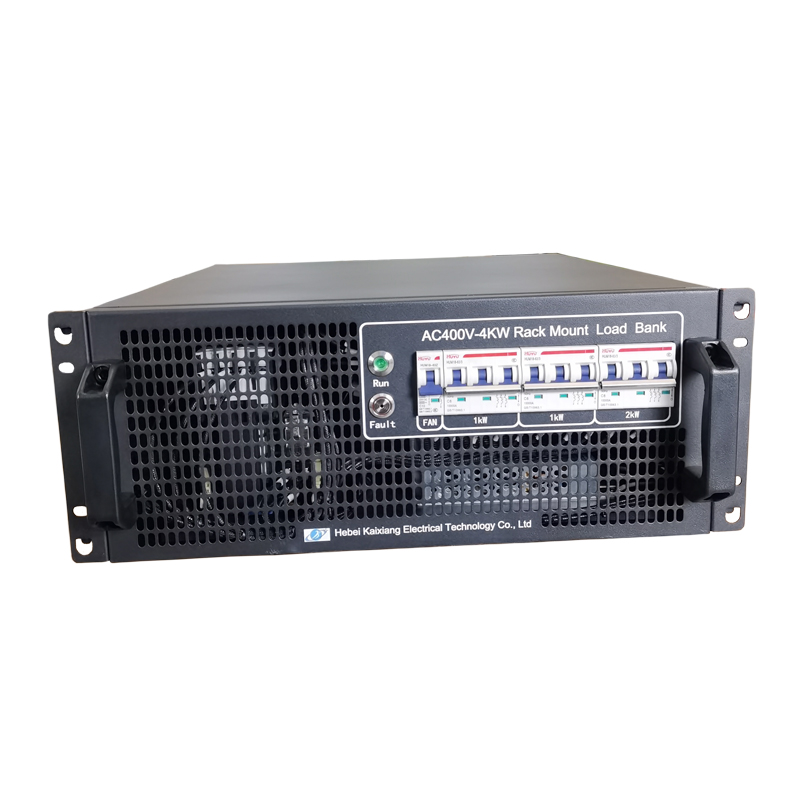
4kW Rack Mounted load bank
The following are their main application scenarios:
4kW Rack Mounted load bank
The following are their main application scenarios:
I. Full-Lifecycle Testing for Data Centers
Data centers are the most core application scenario for rack-mounted load banks, covering the entire process from construction, acceptance, operation and maintenance to expansion of the computer room.
Acceptance Testing for New Computer Rooms: Before servers are officially connected to the computer room, rack-mounted load banks replace real IT equipment to simulate the power consumption and heat generation of servers, switches, storage, and other devices. They comprehensively verify the load-carrying capacity, voltage/frequency stability, and switching response speed of the power supply and distribution system (UPS, power distribution cabinets, busbars, generators), as well as the heat dissipation efficiency and airflow organization rationality of the cooling system (air conditioners, liquid cooling), ensuring that indicators such as PUE and power supply reliability of the computer room meet standards.
Regular Inspection During Operation and Maintenance: In the daily operation and maintenance of data centers, load banks are regularly loaded to test the backup duration of UPS batteries, the long-term load stability of generators, and the temperature rise and voltage drop of power distribution lines, troubleshooting hidden dangers such as loose connections and equipment aging, and ensuring the continuous and stable operation of infrastructure.
Verification for Computer Room Expansion/Reconstruction: After adding cabinets or upgrading the power supply or cooling system in the computer room, load banks are used to simulate the load peak after expansion, verifying the carrying capacity of the expanded system and avoiding problems such as insufficient power supply and cooling failure after reconstruction.
Thermal Management and Energy Efficiency Optimization: Simulate cabinet-level heat flow distribution, test the dynamic response capability of air conditioning and liquid cooling systems, optimize hot aisle isolation and airflow organization, reduce hot spots and energy waste, and improve the energy efficiency of data centers.
II. Testing for Communication Industry Infrastructure
Communication base stations, core computer rooms, and 5G data centers have extremely high requirements for power supply continuity, and rack-mounted load banks are key tools to ensure the reliability of communication power systems.
Base Station Power System Testing: Simulate the electrical loads of base station radio frequency equipment and transmission equipment, test the load-carrying performance and switching reliability of base station UPS, DC power supplies, and backup generators, ensuring continuous power supply for base stations when the mains power is interrupted and avoiding communication interruptions.
Acceptance of Communication Core Computer Rooms: Conduct full-link testing on the power supply, distribution, and cooling systems of communication core computer rooms, verify the operating status of equipment under full load and peak load, and ensure the stability of core communication services.
Factory Testing of Communication Equipment: Before communication power supplies, UPS, and other equipment leave the factory, rack-mounted load banks are used to simulate real loads, complete performance testing and aging tests, and ensure product quality meets standards.
III. Power System Verification in the Industrial Field
In industrial scenarios, precision equipment and automated production lines have strict requirements for power stability, and rack-mounted load banks are used for testing and maintenance of industrial power systems.
Testing of Industrial UPS and Backup Power Supplies: Test the load-carrying capacity, voltage fluctuation, and frequency stability of factory UPS and emergency generators, verify their power supply reliability when industrial equipment operates at full load, and avoid production line shutdowns caused by power failures.
Industrial Power Distribution System Inspection: Simulate loads such as industrial motors, frequency converters, and precision instruments, test the carrying capacity of power distribution cabinets, transformers, and transmission lines, and troubleshoot safety hazards such as line overload and overheating.
Supporting Testing for New Energy Industry: In industrial scenarios such as photovoltaics and wind power, test the output performance of energy storage converters and grid-connected inverters, and verify the matching degree between new energy power supply systems and industrial loads.
IV. Scientific Research and Product R&D Testing
Scientific research institutions and power equipment manufacturers use the high-precision and adjustable characteristics of rack-mounted load banks to conduct product R&D, performance verification, and technical research.
R&D Testing of Power Equipment: During the R&D process of products such as UPS, inverters, DC power supplies, and server power supplies, load banks are used to simulate loads under different working conditions (steady-state, dynamic, peak), test the output characteristics, efficiency, and protection functions of the products, and optimize product design.
Scientific Research Experiments and Standard Verification: Carry out scientific research experiments related to power systems and thermal management, verify the compliance of power equipment with industry standards, and provide data support for technological innovation.
Product Aging and Reliability Testing: Conduct long-term load aging tests on power products to evaluate their service life and long-term stability.
V. Other Key Application Scenarios
Testing for Financial/Bank Computer Rooms: Bank data centers and core computer rooms need to ensure 7×24-hour stable operation. Rack-mounted load banks are used for acceptance and regular testing of UPS and power supply systems in computer rooms, ensuring uninterrupted financial transactions and data storage services.
Military/Aerospace Field: Military equipment and aerospace power systems have extremely high requirements for reliability and precision. Rack-mounted load banks can test the performance of power equipment under simulated extreme load conditions, ensuring the safe operation of military and aerospace equipment.
Ship/Transportation Field: In ship power stations and rail transit power supply systems, rack-mounted load banks are used to test the load-carrying capacity of generators and UPS, adapt to the compact installation requirements of vehicles and ships, and ensure the stability of transportation power systems.
News Recommendation
-
 2026-08-21
TriumphLoad to Showcase Advanced Load Banks & Dummy Load Solutions at Middle East Energy 2026
-
 2026-05-28
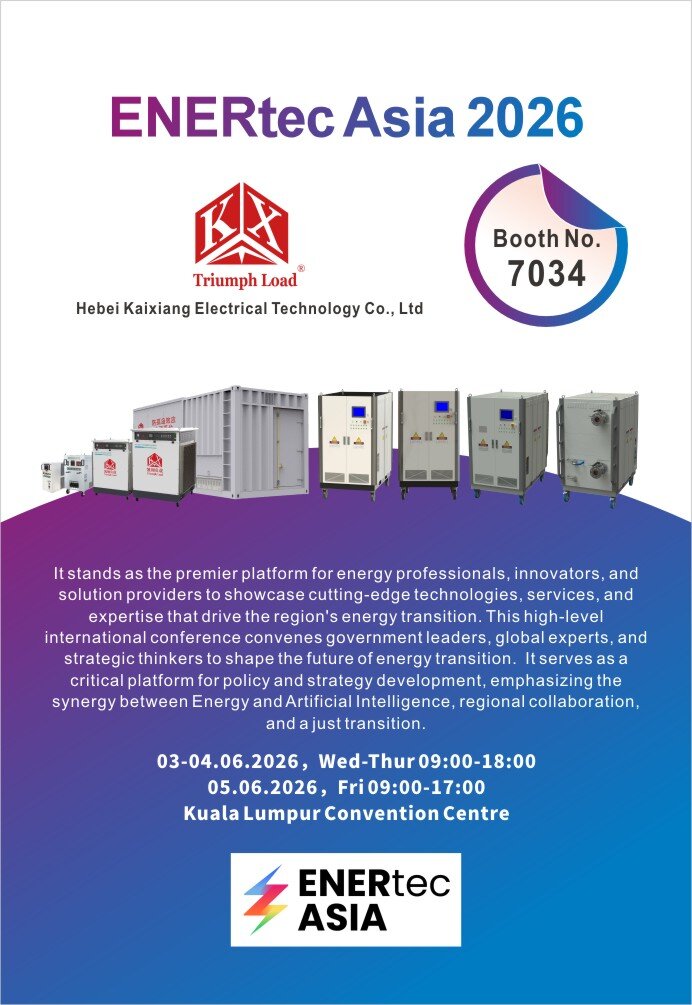
TRIUMPH LOAD EXHIBITING AT ENERTEC ASIA 2026
-
 2024-09-11
TRIUMPH LOAD EXHIBITING AT Enlit Europe 2024 -BOOTH 7.H08
-
 2023-04-21
TRIUMPH LOAD EXHIBITING AT DATA CENTER WORLD GERMANY 2023-BOOTH F909
-
 2023-04-06
TRIUMPH LOAD EXHIBITING AT ELECTRIC POWER TECH KOREA 2023 – Booth G109