Comparison Between Power Frequency and Medium Frequency AC Load Banks: Adaptive Selection in Different Scenarios
Time:2026-05-09
In the field of power testing, AC load banks are core equipment for verifying the performance of power supply devices and simulating load conditions. According to the difference in operating frequency, AC load banks are mainly divided into two categories: power frequency (50Hz/60Hz) and medium frequency (usually 400Hz). There are significant differences between the two in technical characteristics, performance advantages and applicable scenarios. During selection, it is necessary to accurately match them according to testing needs to ensure the accuracy of test results and engineering practicality.
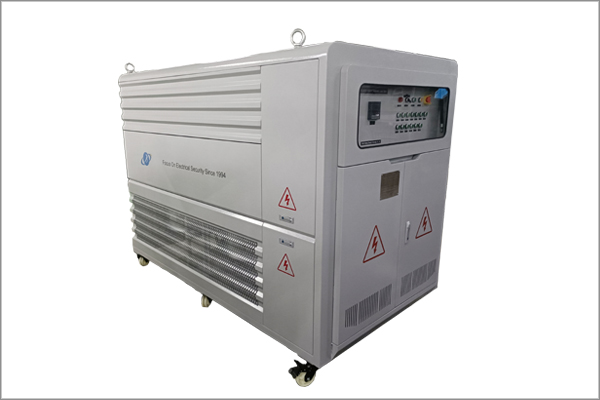
1000kW load bank
1000kW load bank
Power frequency AC load banks operate at 50Hz (domestic standard) or 60Hz (standard in some international regions), and are the most widely used type in the industrial field. Its core advantage is strong adaptability, which can directly match the output frequency of conventional industrial power supplies, civil power supplies and most general power generation equipment, without the need for additional frequency conversion modules. It has a simple structure, stable operation and low maintenance cost. In terms of precision control, the power frequency load bank is optimized for low-frequency working conditions, with high measurement accuracy of voltage and current, and smooth load regulation, which is suitable for scenarios requiring high test stability.
Medium frequency AC load banks, on the other hand, take 400Hz as the core operating frequency, which are mainly designed for the power testing needs of special fields. Due to the characteristics of small size, light weight and high power density of medium frequency power supplies, medium frequency load banks also have the advantages of adapting to high-frequency working conditions and fast response speed. They can accurately simulate the medium frequency power load conditions in fields such as aerospace, ships and military equipment, and meet the performance verification needs of special equipment. However, its structure is relatively complex, the frequency conversion module increases the equipment cost, and the maintenance difficulty is slightly higher than that of power frequency load banks.
In terms of applicable scenarios, power frequency AC load banks are mainly used in general industrial production, data centers, civil power generation equipment (such as diesel generators, UPS), power grid operation and maintenance and other scenarios. They can complete no-load, load, overload tests and stability verification of equipment, and are the most versatile load testing equipment. Medium frequency AC load banks, however, focus on special fields such as aerospace, marine electrical engineering and military communication equipment, and are used to test the performance of medium frequency generators, aviation power supplies, shipborne power supplies and other equipment to ensure their operational reliability under high-frequency working conditions.
Two core principles should be clarified during selection: if the test object is conventional power frequency power supply equipment, and high stability, low cost and versatility are pursued, the power frequency AC load bank should be preferred; if the test object is medium frequency power supply equipment, it is necessary to adapt to 400Hz high-frequency working conditions, and there are high requirements for test response speed, then the medium frequency AC load bank should be selected. In addition, it is necessary to further refine the selection according to parameters such as test power and precision level to ensure that the load bank is perfectly matched with the test object and exerts the best test effect.
News Recommendation
-
 2026-08-21
TriumphLoad to Showcase Advanced Load Banks & Dummy Load Solutions at Middle East Energy 2026
-
 2026-05-28
TRIUMPH LOAD EXHIBITING AT ENERTEC ASIA 2026
-
 2024-09-11
TRIUMPH LOAD EXHIBITING AT Enlit Europe 2024 -BOOTH 7.H08
-
 2023-04-21
TRIUMPH LOAD EXHIBITING AT DATA CENTER WORLD GERMANY 2023-BOOTH F909
-
 2023-04-06
TRIUMPH LOAD EXHIBITING AT ELECTRIC POWER TECH KOREA 2023 – Booth G109