From Air Cooling to Liquid Cooling: The New Generation Load Bank Leads the New Energy and Computing Center with High Power Density
Time:2026-05-18
With the explosive growth of artificial intelligence computing power, the expansion of new energy energy storage, and the large-scale construction of major intelligent computing centers, power testing equipment has ushered in a wave of iterative upgrading. Constrained by limitations in heat dissipation efficiency, space occupation and operating noise, traditional air-cooled load banks can no longer meet the industrial demands of high power and high density. The liquid-cooled load bank has risen to become a new generation of core equipment replacing air cooling, leading the track of new energy and intelligent computing centers with the advantage of ultra-high power density.
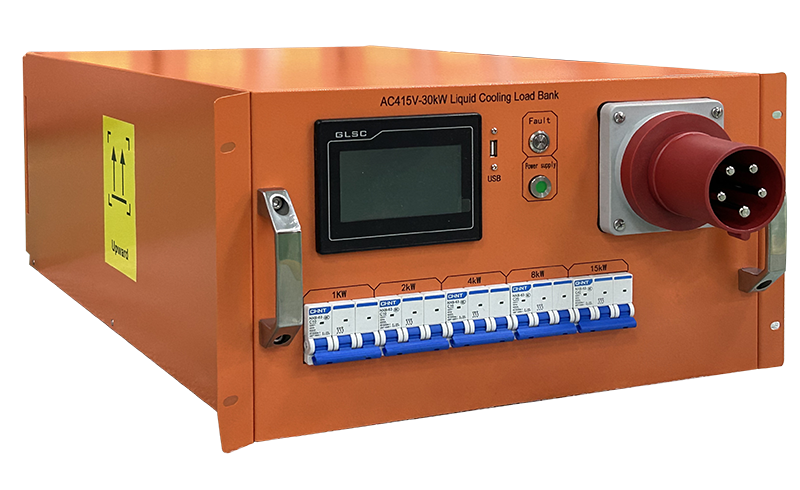
liquid-cooled load bank
liquid-cooled load bank
As essential testing equipment for generator sets and UPS power supplies, the load bank undertakes the key task of simulating power load and verifying equipment stability. Traditional air-cooled load banks rely on fan convection for heat dissipation. Air has limited thermal conductivity, resulting in low power density and bulky equipment size. Meanwhile, the operation noise of fans is prominent, and problems such as uneven heat dissipation and accelerated component aging are prone to occur under long-term high-load operation, failing to adapt to the deployment requirements of high-density computer rooms and compact energy storage power stations.
Liquid-cooled load banks subvert the traditional air-cooled heat dissipation logic and use special cooling liquid as the heat exchange medium. The specific heat capacity and thermal conductivity of liquid are far better than air, and the heat dissipation capacity per unit volume is thousands of times that of air. Relying on the circulating liquid cooling structure, the heat dissipation uniformity of the equipment is greatly improved, which can accurately control the temperature rise of core components and realize high power density integration. It can carry larger loads in a smaller body, perfectly adapt to rack-mounted modular deployment, and greatly save the space of computer rooms.
In the field of intelligent computing centers, high-density server clusters have strict requirements on power supply stability and heat dissipation energy efficiency. Liquid-cooled load banks can complete full-load testing of power systems and power distribution links in computer rooms, helping reduce PUE and realize green and low-carbon operation and maintenance. In the new energy industry, for the grid connection commissioning and routine inspection scenarios of wind power, photovoltaic and energy storage power stations, liquid-cooled load banks can run stably at full load for a long time without fear of complex working conditions. Meanwhile, the operating noise is significantly lower than air-cooled equipment, suitable for silent operation and maintenance in factory parks.
With the further implementation of carbon peaking and carbon neutrality policies and the continuous expansion of computing power infrastructure, high power, energy saving and miniaturization have become the mainstream development trends of the load bank industry. The technological leap from air cooling to liquid cooling is an inevitable trend of the industry. With the core advantages of high power density, high energy efficiency and high stability, the new generation liquid-cooled load bank continues to deeply engage in scenarios such as intelligent computing centers, new energy storage and industrial power detection, and will continue to lead the upgrading and transformation of the power load testing industry in the future.
News Recommendation
-
 2026-08-21
TriumphLoad to Showcase Advanced Load Banks & Dummy Load Solutions at Middle East Energy 2026
-
 2026-05-28
TRIUMPH LOAD EXHIBITING AT ENERTEC ASIA 2026
-
 2024-09-11
TRIUMPH LOAD EXHIBITING AT Enlit Europe 2024 -BOOTH 7.H08
-
 2023-04-21
TRIUMPH LOAD EXHIBITING AT DATA CENTER WORLD GERMANY 2023-BOOTH F909
-
 2023-04-06
TRIUMPH LOAD EXHIBITING AT ELECTRIC POWER TECH KOREA 2023 – Booth G109