What Are the Advantages of Air-Cooled and Liquid-Cooled Load Banks in Testing?
Time:2026-01-30
In the performance testing and acceptance of power equipment such as generators, UPS power supplies, and energy storage systems, load banks serve as core devices for simulating actual electrical loads. Their cooling methods directly determine the testing efficiency, applicable scenarios, and operational stability of the equipment. Air cooling and liquid cooling are the two most mainstream cooling technologies for load banks. Relying on different heat exchange principles, they form complementary technical advantages in testing scenarios, adapting to different testing requirements, site conditions, and performance index demands. Clarifying the core advantages of the two cooling methods can help testers select models accurately and improve the professionalism, reliability, and economy of power equipment testing.
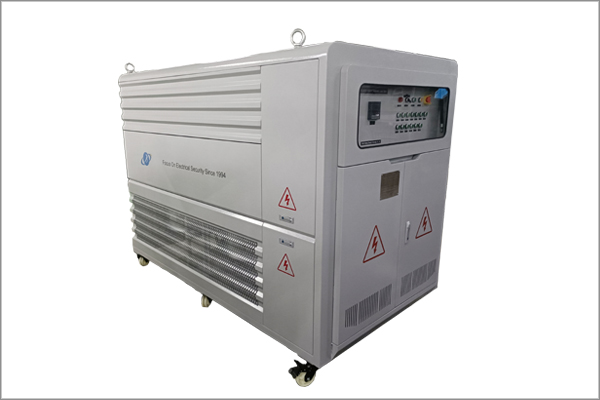
1000kW load bank
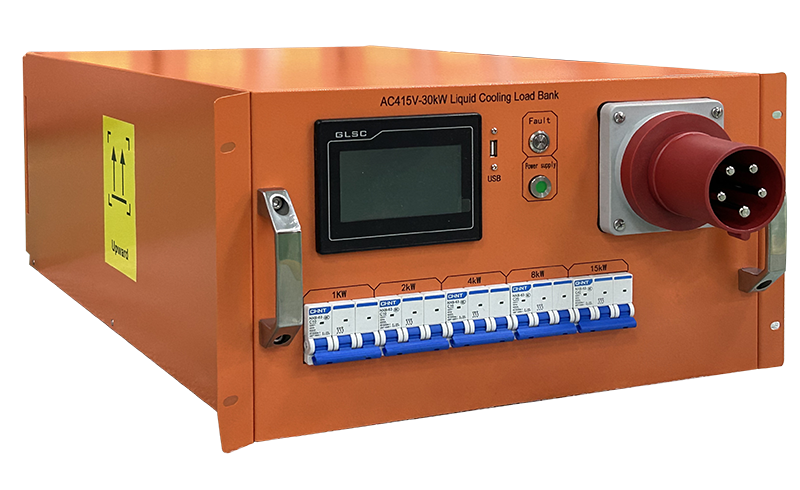
30kW Liquid Cooled Load Bank
1000kW load bank
Air-cooled load banks use air as the heat exchange medium and achieve rapid heat dissipation through forced convection by fans. They are the most widely used type of load bank in industrial testing, with their advantages concentrated in adaptability, convenience, and versatility. Firstly, the installation and deployment of air-cooled load banks do not require additional cooling pipelines, liquid storage devices, or heat exchange units. The equipment has a relatively simple structure and a smaller floor area, making it particularly suitable for temporary testing, mobile testing, and scenarios with limited site conditions—such as outdoor emergency testing of generators, temporary acceptance of UPS at construction sites, and local equipment detection in small data centers. They enable quick on-site entry, debugging, and commissioning, greatly shortening the preparation cycle before testing. Secondly, air-cooled load banks feature low maintenance difficulty. Daily maintenance only requires cleaning and inspecting fans and filters, without the need to monitor the liquid level, temperature, and purity of cooling fluids, nor are there risks such as pipeline leakage, scaling, and freezing cracking. The equipment has a lower failure rate, which can effectively reduce maintenance costs and downtime in long-term continuous conventional testing. In addition, air-cooled load banks have a flexible power adjustment range. Mature technologies are available for air-cooled equipment with small to medium and high power, which can meet the rated load, overload load, and step load testing requirements of most conventional power equipment. Moreover, the procurement cost of the equipment is relatively lower, with a significant cost-performance advantage, making it the preferred solution for small and medium-sized enterprises and conventional testing scenarios.
Liquid-cooled load banks use liquids such as water and ethylene glycol solutions as heat exchange media, achieving efficient heat transfer and centralized heat dissipation through a closed pipeline system. Their core advantages lie in heat dissipation efficiency, power density, and operational stability, making them more suitable for professional testing scenarios with high power, high load, and high precision. First, the specific heat capacity of liquids is much higher than that of air, resulting in higher heat exchange efficiency. Liquid-cooled load banks can carry a larger test power per unit volume, with a power density far exceeding that of air-cooled load banks. They can meet the full-load testing and long-term overload testing requirements of high-power power equipment such as large generators, megawatt-level energy storage systems, and core UPS in large data centers, solving the problems of insufficient heat dissipation and easy temperature drift of air-cooled equipment in high-power scenarios. Second, the heat dissipation process of liquid-cooled load banks is more stable, with smaller temperature fluctuations during equipment operation, which can provide a more stable load environment for testing and effectively improve the accuracy of test data. They are especially suitable for high-precision performance testing and type testing with strict requirements on indicators such as voltage, frequency, and harmonics. Third, liquid-cooled load banks operate with lower noise, and heat can be centrally recovered and utilized through pipelines—for example, recovering the heat generated during the heat dissipation process to heating systems and hot water systems, realizing the secondary utilization of energy and conforming to the industrial development concept of green testing and energy conservation. At the same time, the closed heat dissipation structure of liquid-cooled load banks can effectively isolate external impurities such as dust and water vapor, and the core components of the equipment are less affected by the environment, resulting in better operational stability in harsh industrial environments with high temperature, high humidity, and heavy dust.
30kW Liquid Cooled Load Bank
In addition to their respective core advantages, air-cooled and liquid-cooled load banks can also form combined advantages in practical applications. In some large comprehensive testing bases, a hybrid testing scheme of "air cooling + liquid cooling" can be adopted. Air-cooled load banks are responsible for conventional testing and dynamic load simulation in the medium and low power range, while liquid-cooled load banks undertake full-load testing and extreme performance testing in the high power range. The two cooperate with each other, which can not only cover the testing requirements of the full power range but also optimize the allocation of testing resources and improve the overall testing efficiency. In addition, with technological development, the fan noise reduction technology and air duct optimization technology of air-cooled load banks are constantly upgraded, and the cooling fluid circulation efficiency and pipeline integration of liquid-cooled load banks are continuously improved. The boundary of the advantages of the two cooling methods is also expanding, further meeting the diversified testing requirements.
In summary, air-cooled load banks represent "convenience and versatility", adapting to temporary testing, mobile testing, medium and low power conventional testing, and scenarios with limited site conditions; liquid-cooled load banks represent "efficiency and precision", adapting to high-power testing, high-precision testing, long-term continuous testing, and professional testing scenarios in harsh environments. In the actual testing of power equipment, testers need to comprehensively consider factors such as the power level of the tested equipment, testing accuracy requirements, site conditions, operation and maintenance capabilities, and cost budget to select the appropriate cooling method or adopt a hybrid testing scheme. This allows load banks to give full play to their core role of simulating loads, ensure the authenticity and reliability of power equipment test results, and provide a scientific technical basis for the factory acceptance, commissioning detection, and daily maintenance of power equipment.
News Recommendation
-
 2026-08-21
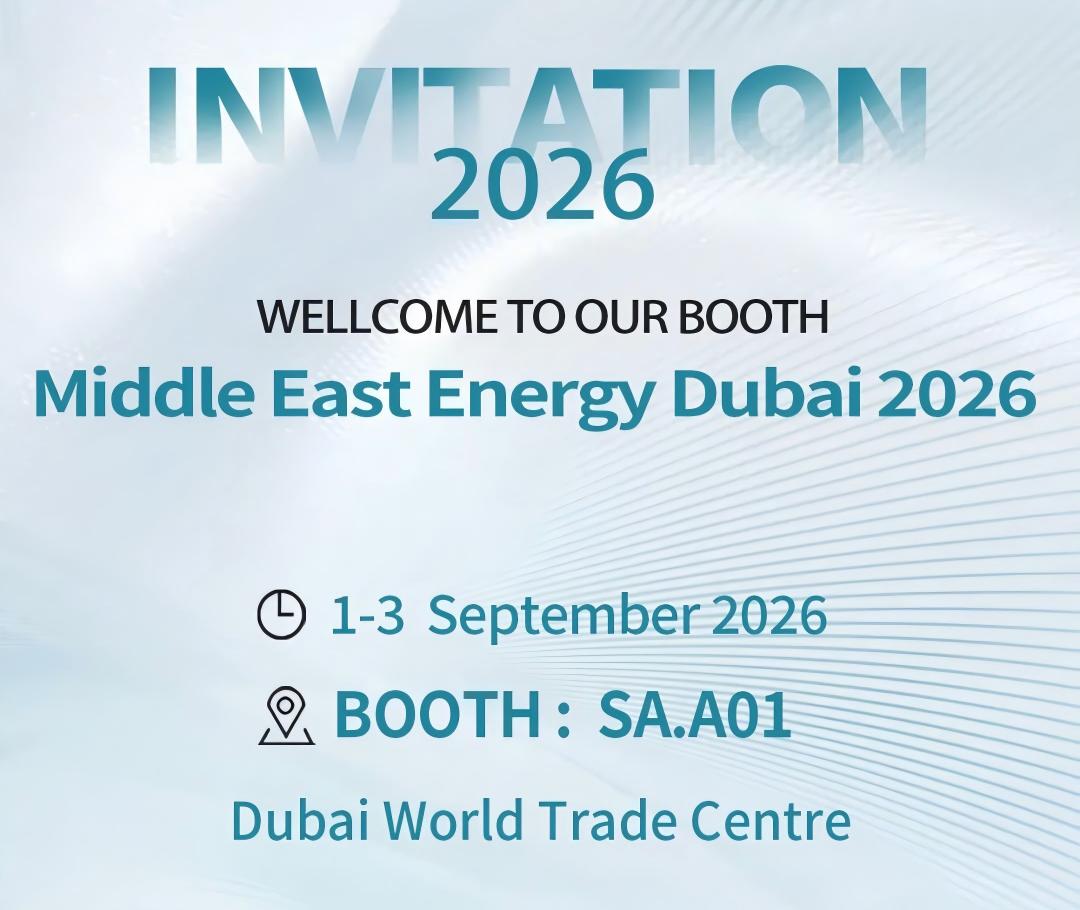
TriumphLoad to Showcase Advanced Load Banks & Dummy Load Solutions at Middle East Energy 2026
-
 2026-05-28
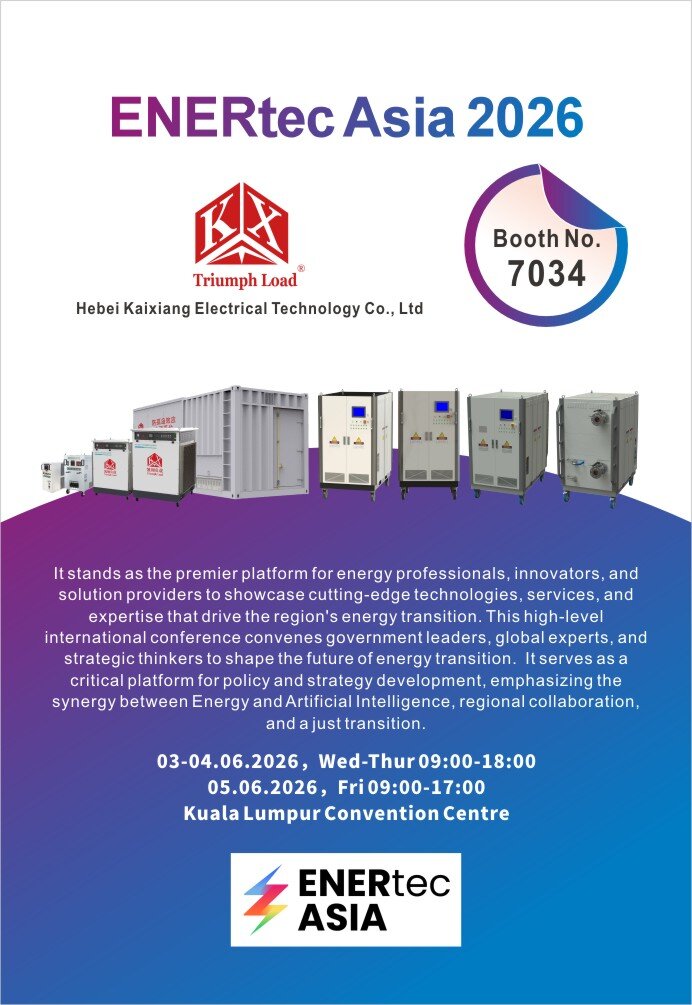
TRIUMPH LOAD EXHIBITING AT ENERTEC ASIA 2026
-
 2024-09-11
TRIUMPH LOAD EXHIBITING AT Enlit Europe 2024 -BOOTH 7.H08
-
 2023-04-21
TRIUMPH LOAD EXHIBITING AT DATA CENTER WORLD GERMANY 2023-BOOTH F909
-
 2023-04-06
TRIUMPH LOAD EXHIBITING AT ELECTRIC POWER TECH KOREA 2023 – Booth G109